Mounting a TV on drywall, also called plasterboard, may seem risky at first. Widely used in both new-build and renovation projects, drywall (and BA13 in particular) is appreciated for its low cost and ease of installation, but its mechanical strength is limited, particularly when faced with heavy loads.
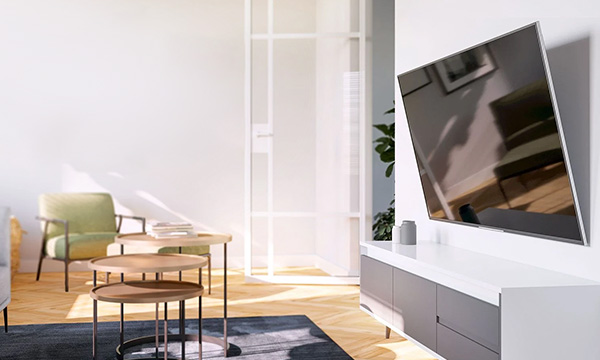
Even so, installing a wall-mounted TV on drywall is perfectly feasible, as long as you folow certain essential rules and choose a TV bracket adapted to the TV’s weight and intended use. Whether fixed, tilting or with an articulated arm, each solution has its own specific constraints, which you need to understand before taking the plunge.
Which TV bracket to choose for drywall
Choosing the right TV bracket is decisive in ensuring reliable, long-lasting mounting.
A fixed TV mount, flush with the wall, is the simplest and safest solution. As the TV remains close to the wall, the force exerted on the mounting points is mainly vertical. With drywall-compatible metal screw anchors, this type of support is suitable for most TVs, as long as their weight remains reasonable.
A tilting TV bracket is a good alternative when the TV needs to be installed slightly higher than the ideal position, for example to make room for a piece of furniture or a center speaker. In this case, the bracket allows the screen to be tilted towards the viewers without moving it away from the wall, therefore limiting stress on the drywall.
A TV bracket with an articulated arm is the most restrictive. The weight of the TV, combined with the leverage exerted when the screen is moved away from the wall, can exceed the strength of the drywall. Therefore, it is not recommended to mount the TV directly onto drywall without a specific technical solution.
Rules for a secure installation
A number of factors must be taken into account before installation:
- the weight of the TV, including the mount,
- the type of partition (drywall thickness, presence of metal rails or wooden beams),
- the mounting method used.
For fixed and tilting wall mounts, it’s generally not necessary to use the metal rails in the wall, except for very heavy TVs. On the other hand, for a TV mount with an arm, it is often essential either to fix the mount onto the rails or beams where these are accessible, or to go and find the load-bearing wall behind the plasterboard.
There are also solutions specially designed for drywall partitions, allowing you to install a TV on an arm while distributing part of the weight to the floor, thereby limiting the stress on the wall.
How to hide the cables on a wall-mounted TV
For an aesthetically pleasing finish, it's best to anticipate cable management when building or renovating the partition, by using cable ducts embedded in the drywall. When this is not possible, cable covers are a simple and effective alternative. They enable power and HDMI cables to be neatly concealed while remaining accessible.
What you’ll find in the full guide
To help you choose the solution best suited to your setup, our detailed guide answers the most frequently asked questions and takes you step by step through the process. In particular, you’ll discover:
- how to mount a TV on drywall with a wall bracket flush with the wall,
- when a tilting TV bracket can be used on drywall,
- what precautions need to be taken when installing a TV bracket with an arm on drywall,
- a solution specifically designed for drywall, enabling TVs to be mounted safely.
👉 To find out more and avoid any mistakes, read our guide: How to mount your TV on drywall


