Outdoor speakers are ideal for adding rhythm to your days spent in the garden, by the pool and at the beach, or even for livening up parties on the patio. Tropicalized and waterproof, these speakers are designed to withstand bad weather and various climates. From passive speakers with an additional amplifier for the terrace to compact battery-powered models to follow you everywhere, there are many solutions for listening to music outdoors. So, which outdoor speaker should you choose? Find out in this comparative guide of the best outdoor speakers of 2026.

Which IP rating?
Several levels of protection and sealing certify the possible uses of an outdoor speaker. While all portable Bluetooth speakers can be taken into the garden, some models will be more suited to the hazards of the outdoors. So-called “tropicalized” models are resistant to prolonged exposure to humidity. It is possible to use them outdoors in damp weather, but they can’t be used in the rain or near a swimming pool.
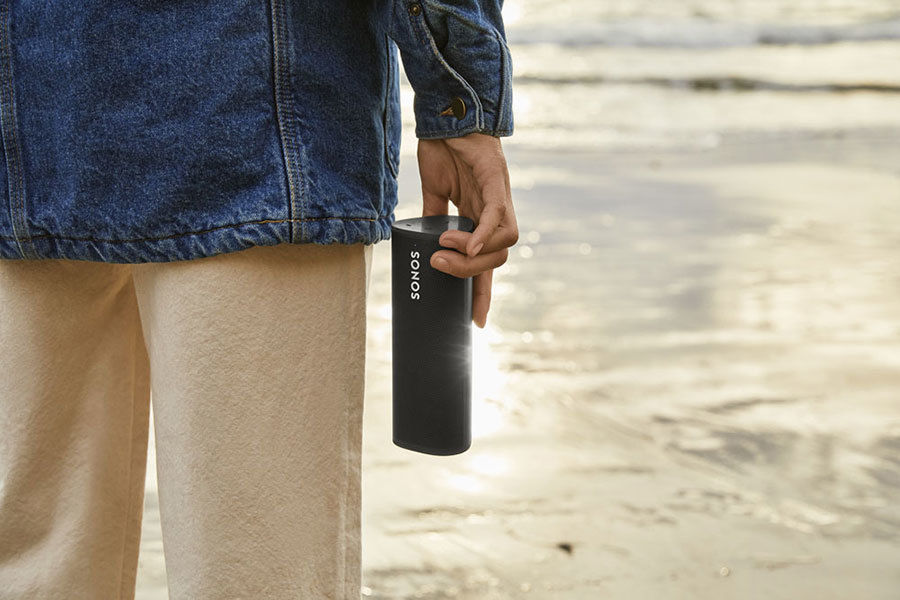
For superior protection, you can opt for splash and immersion resistant speakers. This capability is certified by the international IP standard. The IP rating is always followed by two numbers and/or a letter. The first digit defines the degree of protection against the ingress of solid foreign objects, such as dust. The second defines the degree of protection against liquids. For example, the Sonos Roam 2 speaker is IP67 certified, meaning it’s fully dust-proof and can be submerged up to 1 meter for 30 minutes. Here is a table of the different IP standards. You can also read our guide: Understanding IP standards.
| Ingress protection (IP) | 1st digit: protection against solid foreign objects | 2nd digit: protection against water and liquids |
| 1 | Protected against solid objects over 50mm. | Protected against vertically falling drops of water |
| 2 | Protected against solid objects over 12.5mm | Protected against direct sprays of water up to 15° from the vertical. |
| 3 | Protected against solid objects over 2.5mm | Protected against direct sprays of water up to 60° from the vertical. |
| 4 | Protected against solid objects over 1mm | Protected against water splashed from all directions |
| 5 | Protected against dust and other microscopic residues | Protected against jets of water from all directions (6.3mm nozzle, distance 2.5 to 3m, flow rate 12.5l/min ±5%) |
| 6 | Totally protected against dust | Protected against strong jets of water from all directions (12.5mm nozzle, distance 2.5 to 3m, flow rate 100l/min ±5%) |
| 7 | Protected against the effects of temporary immersion (up to 1m) and for 30 minutes. |
Portable or wired Bluetooth speaker?
Many solutions exist for listening to music outdoors. The easiest way is to use a portable Bluetooth speaker. These are a practical solution for occasionally enjoying your music during a party, a barbecue or a relaxing day by the pool. You can easily carry them from one corner of the garden to another, depending on your needs. In good weather, any Bluetooth speaker can be used outdoors, placed on the corner of the table or in a relatively shaded area. However, for use at the edge of a swimming pool, it is essential to choose an speaker resistant to splashes or, ideally, to immersion. To do this, you can use the previous table of the IP standard. Among these waterproof speakers, the reference models are the Sonos Move 2 and Marshall Emberton III.

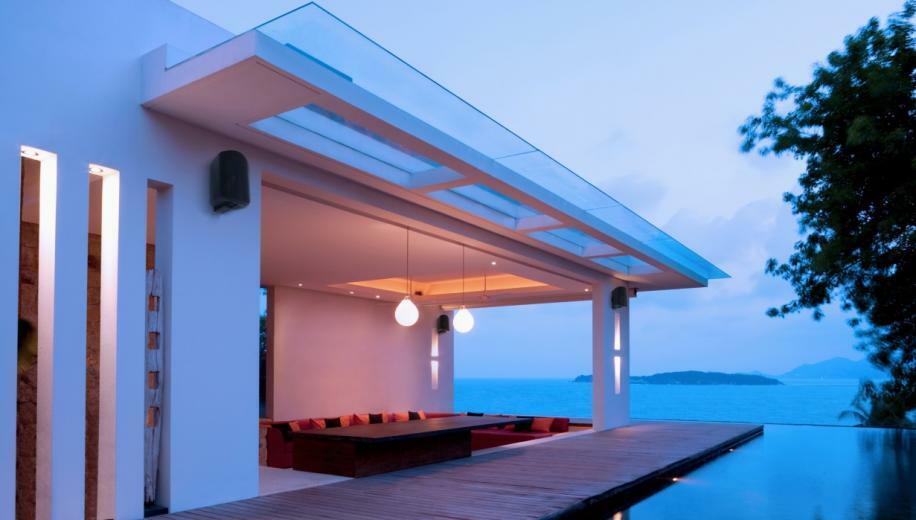
Portable Bluetooth speakers are convenient, but you need to store them at home and charge them after each use. In addition, their power is often limited. If you need a solution that can stay outside all the time to enjoy music on the terrace, under a gazebo or around a swimming pool, outdoor speakers can be a better alternative. To adapt to all possible configurations, there are many models, the details of which you can find in the guide: the different types of outdoor speakers. For the terrace or patio, wall-mounted speakers such as the Focal 100 OD8, Elipson Rain 6 and B&W AM1 (read the B&W AM1 speaker review) are particularly suitable. The latter are accompanied by an adjustable wall bracket to easily direct them towards the listening area. They can be controlled using a smartphone when powered by a connected amplifier.

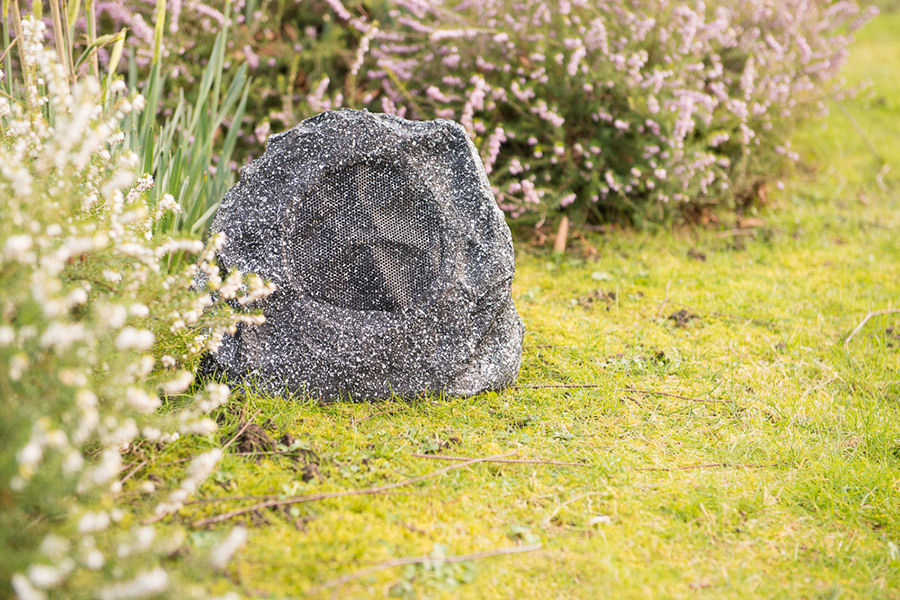
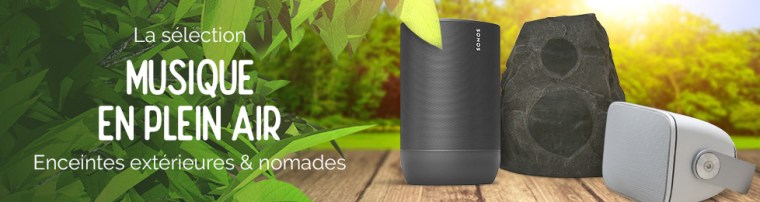
During renovation or extension work, you can opt for built-in outdoor speakers such as the KEF CI 160QL. Placed in the walls or under the slope of the roof, the latter ensure total integration. For a swimming pool or a gazebo located in the middle of the grounds, you can use garden speakers like the Focal OD Sat 5 which are easily hidden in the vegetation or along the paths. For even more discretion, there are also outdoor speakers that imitate the shapes and colors of real rocks. Reference models are the Klipsch PRO-650T-RK Rock, Earthquake Granite-52 and Sonance RK63.

Active or passive outdoor speaker?
An outdoor speaker is said to be active when it incorporates its own amplification. All waterproof portable Bluetooth speakers are therefore active models. They work in total autonomy, for easy implementation. Thanks to their built-in battery and amplification, you can place the speaker wherever you want to instantly play music. Conversely, outdoor wall or floor speakers are almost always passive. This means that you have to run speaker cables to connect them to an amplifier, which is placed inside the house. For easier use, we recommend choosing a connected amplifier like the Sonos Amp to control the music in the garden from a smartphone or tablet.
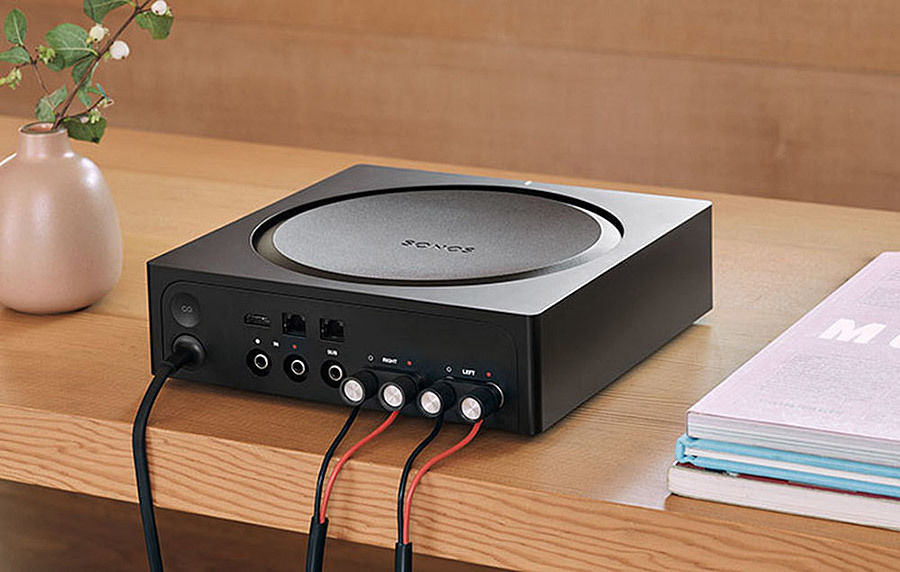
Note that there are a few active outdoor speakers, such as the Lithe Audio Bluetooth Garden Rock Speaker. It has an integrated amplification of 2 x 30 watts and can receive music via Bluetooth. However, a power supply is still necessary.
What power for an outdoor speaker?
When the speaker is placed next to the garden furniture or the deck chair, any model, even of modest power, can be used. Models like the JBL GO 4 and Altec Lansing HydraMini are perfect for this. These speakers are also ideal for traveling light and with minimal bulk.

However, the smaller the speaker, the smaller and fewer the drivers will be. However, large drivers are essential to enjoy powerful sound and deep bass. To liven up evenings by the pool, you will need larger speakers, capable of delivering higher power. The majority of wired outdoor speakers are capable of delivering enough power for your biggest parties, provided you pair them with an amplifier that matches their performance. For example, the Elipson Rain 8 speaker has a power handling capacity of 150 watts and benefits from a large 7.8″ midbass driver to ensure excellent acoustic performance in all environments. For even more powerful bass, you can also pair it with an external subwoofer like the Klipsch PRO-10SW-RK Rock.
If you want to retain the mobility of portable Bluetooth speakers while maximizing bass power and volume, it is best to opt for larger speakers like the Eltax Voyager BT 12 MKII. Finally, you can also use battery-powered party speakers. Although they are more cumbersome than conventional portable speakers, they have the advantage of being equipped with very large drivers, combined with generous amplification. For example, the JBL PartyBox Stage 320 speaker has 240 watts of power, 18 hours of battery life and two 6.7″ woofers to deliver powerful bass.

Connectivity and wireless streaming
If you opt for a portable Bluetooth speaker, outdoor music streaming will mainly be carried out via Bluetooth from a smartphone, tablet or computer. Some portable speakers are also WiFi compatible to access many streaming services, web radios or AirPlay and Chromecast streaming. However, you will have to stay within the perimeter covered by the home WiFi network. To take advantage of these features at the other end of the garden, you might need to extend your network with a WiFi Mesh system. Finally, some portable speakers like the Roberts Beacon 325 also have a mini-jack input to connect a DAP, for example. For party speakers like the JBL PartyBox 710, the range of connectors is often more extensive, with RCA, microphone and guitar inputs.

With a passive outdoor speaker, the connectors depend exclusively on the amplifier that you want to use. Once again, choose a connected model to control the music, manage the volume and select the different sources remotely. To make the right choice, you can refer to the comparative guide of the best WiFi/Bluetooth connected amplifiers.
Which outdoor speaker is the best?
We’ve sifted through the different types of outdoor speakers throughout this guide. These fall into two broad categories: portable Bluetooth speakers and wired outdoor speakers. Portable models are ideal for occasional use and to follow you on the go, whether in the garden, on vacation or at the beach. Wired speakers are intended exclusively for domestic use, by the pool, on the terrace or in a patio. They will significantly extend the listening area outdoors. To make your choice easier, we have compiled a list of the market leaders for these two categories of outdoor speakers:
The best portable outdoor speakers:
- Sonos Roam 2: IP67, WiFi and Bluetooth, 10h battery life
- Marshall Emberton III: IP67, Bluetooth, 32h battery life, 20W power
- Sonos Move 2: IP56, WiFi and Bluetooth, AirPlay 2 and voice controls, 24 hour battery life
- JBL PartyBox Stage 320: IPX4, Bluetooth, 18h battery life, 240W power
The best wired outdoor speakers:
- Artsound ASW55.2T: 60W, 2-way, 5″ midbass driver, wall or ceiling
- Elipson Rain 6: 120W, 2-way, 6.5″ midbass driver, wall or ceiling
- Focal 100 OD8: 150W, 2-way, 8″ midbass driver, wall or ceiling
- Earthquake AWS-802: 100W, 2-way, 7.9″ midbass speaker, wall or ceiling
- Elipson Rain 8: IPX4, 150W, 2-way, 7.9″ midbass driver, wall or ceiling
- Focal OD Sat 5: 100W, 2-way, 5″ midbass driver, ground speaker
- Klipsch AWR-650: 50W, 2-way, 6.5″ midbass driver, rock speaker
- B&W AM1: 100W, 2-way, 5″ midbass driver, wall or ceiling
Want to go further with a portable Bluetooth speaker that you can take into the garden? Need a solution to listen to music throughout your home with connected speakers? Discover our other comparative guides of the best speakers for all situations:
- A comparison of the best portable Bluetooth speakers
- A comparison of the best connected speakers
- A comparison of the best party speakers
Frequently asked questions
Yes, outdoor speakers are designed to withstand various weather conditions and extreme temperatures. They can be left outside all year round.
The recommended power output for sound systems in outdoor spaces depends on several factors, including the size of the space, the ambient noise level and the type of activity. However, here are a few guidelines:
Under 20m²: 10 to 30 watts.
20 to 50m²: 30 to 50 watts.
Over 50m²: over 60 watts. A high-power system is required to fill the space without the sound being distorted.
If you use a multi-zone amp or a network player, an outdoor installation can be added to a multi-room system.
An outdoor speaker works like a regular speaker. It has a passive design and needs to be connected to an amplifier. Therefore, the amplifier should be placed in a dry, temperate location, and cables should be run to the speakers.
Bluetooth speakers usually have compact formats so they’re easy to carry. They can provide sound in small spaces and will provide background music for an afternoon outdoors. To enjoy the same sound quality as in a dedicated listening room, you will need to install a true outdoor stereo system.
Installing an audio system in the garden requires more or less work depending on the distance between the amplifier and the speakers. In fact, installing a system in a garden involves digging trenches to lay the cables needed to power the speakers. For a patio, you can simply run the cables along the walls.
The larger the space is, the more speakers you need. This is why a multi-zone amplifier can be useful. It allows you to play music in several different areas of a home, with independent control for each zone. However, if the distance between each speaker and the amplifier is greater than 100 metres, it is preferable to opt for a 100-volt amplifier and speakers. Adding a network player makes it easier to control the system remotely (power, volume, etc.).
The noise perceived by others must not exceed 5 decibels (dB) during the day and 3 dB at night, to which a corrective factor is added depending on the duration, according to the government website.
A soft, dry cloth is sufficient for removing dust and dirt. Avoid using rough cloths that could scratch the surface.


