75-inch televisions, which used to seem gigantic, are now superseded by increasingly large models: 85″, 98″, and more. That fact that manufacturers are producing such TVs raises questions: what are the advantages of such sizes? Does it make sense to invest in a TV rather than a 4K UHD projector or an ultra short-throw projector? What are the differences between TV picture and “cinema” picture?
What’s the point of having a very large TV?
With a screen measuring 2 meters or more across, an XXL TV is like a window looking out onto the world. It displays life-size pictures! For movies, documentaries, series and even for video games, it guarantees total immersion. Viewers are literally plunged into the heart of the image.
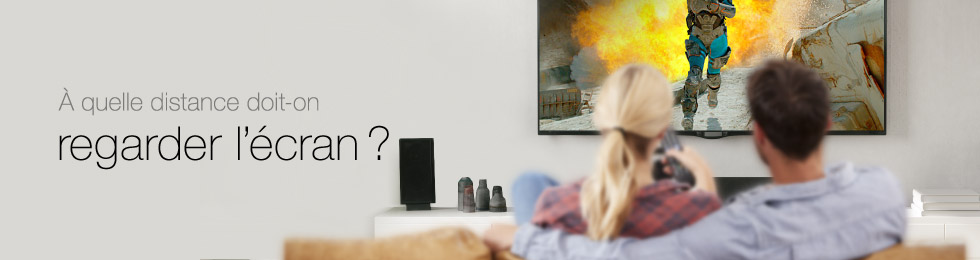
But such a screen size requires a lot of space. First to make room for it on the wall. Then to have enough space to enjoy it. A 4K UHD TV of 85″ or more requires that you are seated at least 3.5m to 4m away from the screen for a comfortable experience. This distance can be reduced slightly to enjoy a more immersive cinematic effect with movies.
Why not choose a projector?
Confronted with a TV screen ranging from 85 to 97 inches, one is entitled to wonder. Moreover, in most cases, a very large television costs the same amount as a high-performance projector with a high-quality projection screen. And with a projector, you can enjoy a much larger image.
Recent progress in the field of projection (high brightness, HDR, extended color space) is an argument in favor of projectors. But to achieve a large, bright and contrasted image in projection, the room needs to be at least partially dark (if not completely dark). In the middle of the day or in a bright room, TVs have an advantage.

An ultra short throw projector allows you to achieve a very large 4K HDR image, without the constraints of an XXL TV. Lighter, more compact, and more discreet, they are very easily forgotten once turned off. Whereas a very large TV is visually imposing even when turned off. However, if you opt for a projector with a fixed screen, the aesthetics will still be impacted…
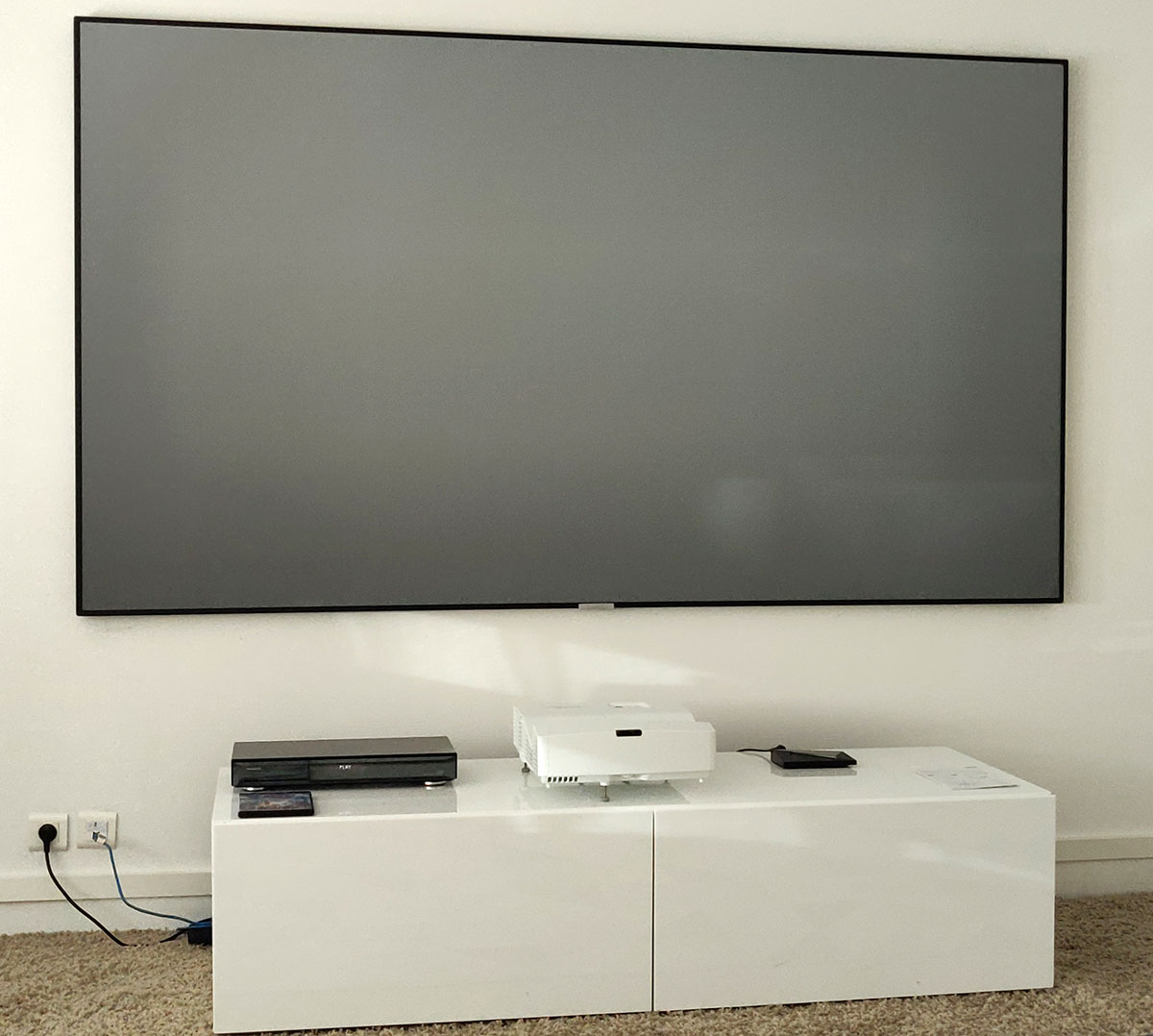
Finally, even with a technical screen, the contrast and color saturation are lower with an ultra short throw projector during the day. This is due to the difference in intensity between direct light (TV) and reflected light (projection).
Direct light and reflected light
You have probably already noticed that the picture always seems more intense and brighter on a television than with a projector, which is often softer. This is due to the way the light that makes up the picture reaches the viewer’s eyes. With a TV, the diffusion is frontal. The TV generates the light of the image, which reaches the viewer’s eyes directly. The colors are therefore more vivid and saturated, the dynamic range is higher, and the contrast greater. This is even truer with OLED technology, which displays total black, and therefore exceptional contrast.
With a projector, the light from the image is reflected by the screen before reaching the retina. The light is therefore partially absorbed by the screen. The picture loses a bit of intensity and takes on a duller appearance. It seems softer, more delicate. This is what projection enthusiasts appreciate and what gives cinema-like images their charm. But if the room is not dark, the screen reflects not only the light from the projector (the projected image), but also the ambient lighting. The projected image then seems very dull.
See our article: What is light pollution and how can it be eliminated?
In a living room, to watch daily TV programs but also for movies and video games, a very large TV is therefore preferable to a projector. However, the latter remains unequaled for home theater in the eyes of movie lovers.
Very large TV or projector?
There’s nothing like a very large screen to enjoy an unparalleled feeling of immersion in front of a film or a video game. This is true whether you choose a 4K XXL TV, an ultra short throw projector plus a fixed projection screen or a 4K projector and a motorized screen.
Two parameters must be taken into account when choosing between one or the other: the environment in which the picture is displayed, and the desired result.
In a very bright living room or in a TV room with untreated light pollution, an XXL TV is a must, notably bright Mini LED models. The same applies if you mainly watch TV during the day.

An ultra short throw projector with an ALR screen is a very interesting alternative. Especially if you can darken the room a little with curtains. For the same image size, this solution can also be less expensive.
In a room that can easily be made dark, and particularly in a dedicated room, the projector is the best solution for obtaining a cinematic image.

There remains the question of the appearance of the desired image. This is a rather subjective issue. Some consider that nothing beats the brightness and color saturation achieved with HDR TVs. What really counts is getting the most out of your favorite movies, TV shows and video games.


